On this page
Why skincare faces TikTok Shop’s strictest AIGC rules
Skincare is one of the top-performing categories on TikTok Shop for a reason: serums, SPF, cleansers, and routines convert when the creative feels native. Shoppers pause for bathroom-mirror GRWMs, dropper close-ups, and POV reviews that look like they belong in the feed. That same visibility is why beauty also sits under the hardest AI-generated content (AIGC) scrutiny in 2026.
TikTok Shop is not trying to ban AI UGC. Realistic AI avatars, synthetic voices, and AI-rendered product demos are allowed when sellers disclose them correctly and avoid prohibited medical or exaggerated claims. What gets accounts into trouble is the combination of unlabeled synthetic creators plus FDA-style language that sounds like a treatment promise.
If you sell or affiliate on TikTok Shop, treat disclosure and claim safety as part of creative production—not a last-minute checklist. The rest of this guide walks through the 2026 disclosure toggle, the hard prohibitions for beauty ads, a safe-vs-banned copy table, and a workflow for testing GRWM and POV hooks without shipping samples.
Mandatory TikTok Shop AI disclosure rules in 2026
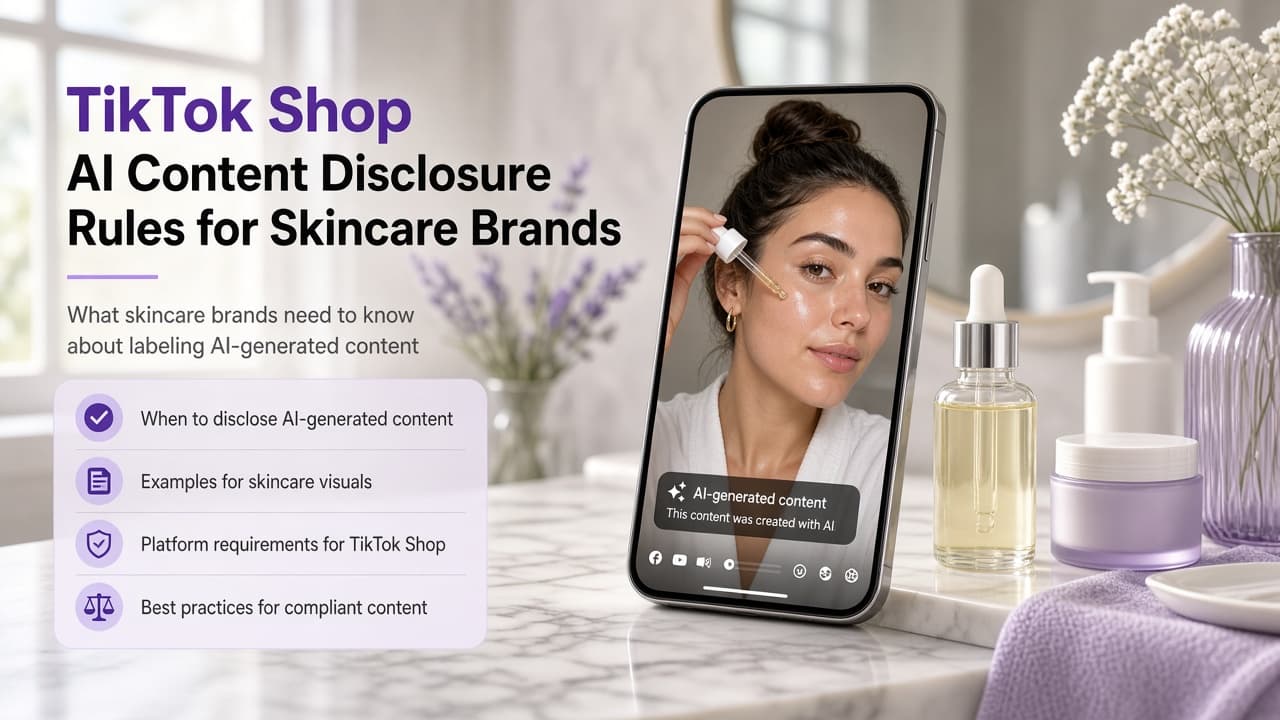
When a video uses realistic AI media, TikTok expects an AI-generated content label. For TikTok Shop sellers and affiliates, that usually means enabling the platform’s built-in “AI-generated content” disclosure when the creative includes realistic AI avatars, synthetic voiceovers, or AI-rendered product application demos that a viewer could mistake for a real person or real footage.
Minor AI assist is different from full AIGC. Auto-captions, noise reduction, color correction, and simple cut suggestions generally do not require the same disclosure as a photoreal presenter who never held your serum. If the face, voice, or product demo is synthetic and looks real, disclose it. If you only cleaned audio and burned captions onto a real phone clip, you are usually in editing territory—not unlabeled AIGC.
Skipping the label on realistic AI creators is where shadowbans and removals start. TikTok’s enforcement is uneven week to week, but unlabeled synthetic presenters in Shop creatives are a common reason videos lose distribution or get taken down. Disclosure does not hurt performance the way a ban does. Treat the toggle as mandatory production hygiene for any AI UGC you push into TikTok Shop.
- Toggle AI-generated content disclosure for realistic AI avatars, synthetic voices, and AI-rendered demos.
- Do not confuse captions or auto-cuts with full AIGC that needs a label.
- Unlabeled realistic AI creators risk limited reach, removals, and Shop friction.
- Keep a record of which assets are AIGC so your team labels every upload consistently.
Quick disclosure checklist before you post
- Does the video show a photoreal person who was not filmed? → Label as AIGC.
- Is the voice synthetic or heavily AI-cloned? → Label as AIGC.
- Is the product application rendered by AI rather than filmed? → Label as AIGC.
- Did you only add captions, crop, or color grade real footage? → Editing assist; still follow claim rules.
Strict prohibitions for skincare & beauty AI ads
Disclosure alone will not save a video that breaks TikTok Shop’s beauty guardrails. Skincare ads sit next to health and appearance claims, so moderation is aggressive. Three patterns cause the fastest problems for AI UGC sellers and affiliates.
No impersonation. Never use AI avatars that present as licensed dermatologists, doctors, nurses, or real celebrities. Fake authority and celebrity likenesses are hard policy failures, and synthetic “doctor reviews” are among the easiest ways to lose a Shop listing’s distribution.
No fear-based or exaggerated imagery. Distorted before-and-after skin, extreme acne or eczema visuals, and shock “transformation” frames designed to frighten viewers into buying are high-risk. Keep application and texture honest; do not invent diseased skin states your product never treated on camera.
FDA and medical claim guardrails matter as much as visuals. Words like “cures acne,” “clinically proven to erase wrinkles,” or “medical-grade” often trigger instant TikTok Shop violations because they sound like disease treatment or guaranteed clinical outcomes. Stick to sensory, routine, and appearance language you can support: texture, absorption, how it layers under SPF, and how skin looks after use—not cure claims.
- Never cast AI presenters as licensed medical professionals or celebrities.
- Avoid scare-tactic before/after skin distortion and graphic condition imagery.
- Replace disease-cure and “clinically proven erase” language with appearance and routine claims.
- If a claim needs a medical study to defend, it probably does not belong in a Shop UGC hook.
Safe vs. banned skincare ad copy
Most TikTok Shop beauty violations start in the first three seconds of copy. The table below rewrites common risky phrases into TikTok-safer alternatives for serums, sunscreens, and cleansers. Use the right column as a drafting filter before you generate or publish AI UGC.
Keep a living swipe file of approved lines for each SKU. When a hook fatigues, swap only the opening line and keep the compliant body. That is how you get testing volume without drifting back into banned medical language.
Risky phrases vs TikTok-compliant alternatives
| Risky phrases (triggers ban) | TikTok-compliant alternatives |
|---|---|
| “Cures cystic acne overnight” | “Helps calm visible redness and supports clearer-looking skin” |
| “Clinically proven to erase wrinkles” | “Lightweight serum that layers smoothly under makeup” |
| “Medical-grade sunscreen that blocks all UV” | “Daily SPF with a sheer finish and low white cast” |
| “Dermatologist-approved miracle cleanser” (unsourced) | “Gentle foaming cleanser for morning and night routines” |
| “Removes eczema in one wash” | “Leaves skin feeling refreshed after washing; patch-test if sensitive” |
| “Guaranteed glass skin in 3 days” | “Shows a hydrated, glowy finish after absorption” |
How to scale compliant skincare ads without shipping samples
The operational advantage of AI UGC for TikTok Shop is speed: you can test GRWM and POV hooks without waiting on sample shipping or creator turnaround. The compliance advantage is control: you can standardize disclosure labeling and scrub medical buzzwords before a video ever hits Shop.
A practical weekly system looks like this. Start from a clear product photo or product link. Choose a GRWM or POV template and a realistic creator demographic that matches your buyer—not a “dermatologist” persona. Draft hooks around hydration, texture, white cast, layering, or routine fit. Run the script through a banned-phrase filter. Render 9:16 variants, enable TikTok’s AI-generated content disclosure on every upload, and retire weak hooks on hook rate rather than inventing stronger medical claims.
Affiliates benefit from the same loop because they often never hold inventory. Instead of filming every SKU themselves, they can generate compliant promotions for multiple brands, disclose AIGC correctly, and keep copy inside appearance and routine language. Brands can do the same for catalog depth without mailing dozens of jars to creators for every test.
If you want a workflow purpose-built for this category, AI UGC for TikTok Shop skincare walks through compliance-safe GRWM and POV formats, claim filtering, and fast variant testing from a single product photo. Pair that landing workflow with the disclosure rules above and you get volume without trading Shop access for a short-term hook.
- Test GRWM and POV openings first; keep the body and CTA stable.
- Filter scripts for cure, clinical-guarantee, and medical-grade language before render.
- Label every realistic AI avatar and synthetic voiceover on upload.
- Scale affiliates and catalog tests from photos or links instead of physical samples.
FAQ
Does TikTok Shop ban AI-generated skincare videos?
No. TikTok Shop allows AI-generated skincare creatives when you disclose realistic AIGC and avoid prohibited medical or exaggerated claims. Unlabeled synthetic presenters and cure-style language are what create ban and removal risk.
Do AI UGC videos qualify for the TikTok Creator Rewards Program?
Creator Rewards eligibility depends on TikTok’s current program rules, which change and often restrict or scrutinize heavily AI-generated content. Do not assume Shop ads or fully synthetic UGC automatically earn Creator Rewards; check the live program terms for your region and content type.
How do I label AI voiceovers or avatars on TikTok Shop?
Use TikTok’s built-in AI-generated content disclosure when posting videos that include realistic AI avatars, synthetic voices, or AI-rendered demos. Apply the label consistently across organic posts and Shop-facing creatives, and keep an internal log of which assets require disclosure.